

E-Commerce Guide: Essential Benelux Playbook for New and Growing Online Shops
1. D2C Versus Retail Networks: Pros and Cons
For Direct-to-Consumer (DTC/ D2C) brand owners, every selected sales channel shapes profit margins, customer relationships, and operational control. Operating purely Direct-to-Consumer provides complete ownership over customer data, brand storytelling, and pricing strategies.
Direct-to-Consumer brands retain direct access to their buyers, enabling them to build long-term loyalty and optimize customer lifetime value without a middleman taking a cut. However, this model requires the brand to bear the full burden of customer acquisition costs (CAC), digital marketing expenses, order fulfillment and logistics.
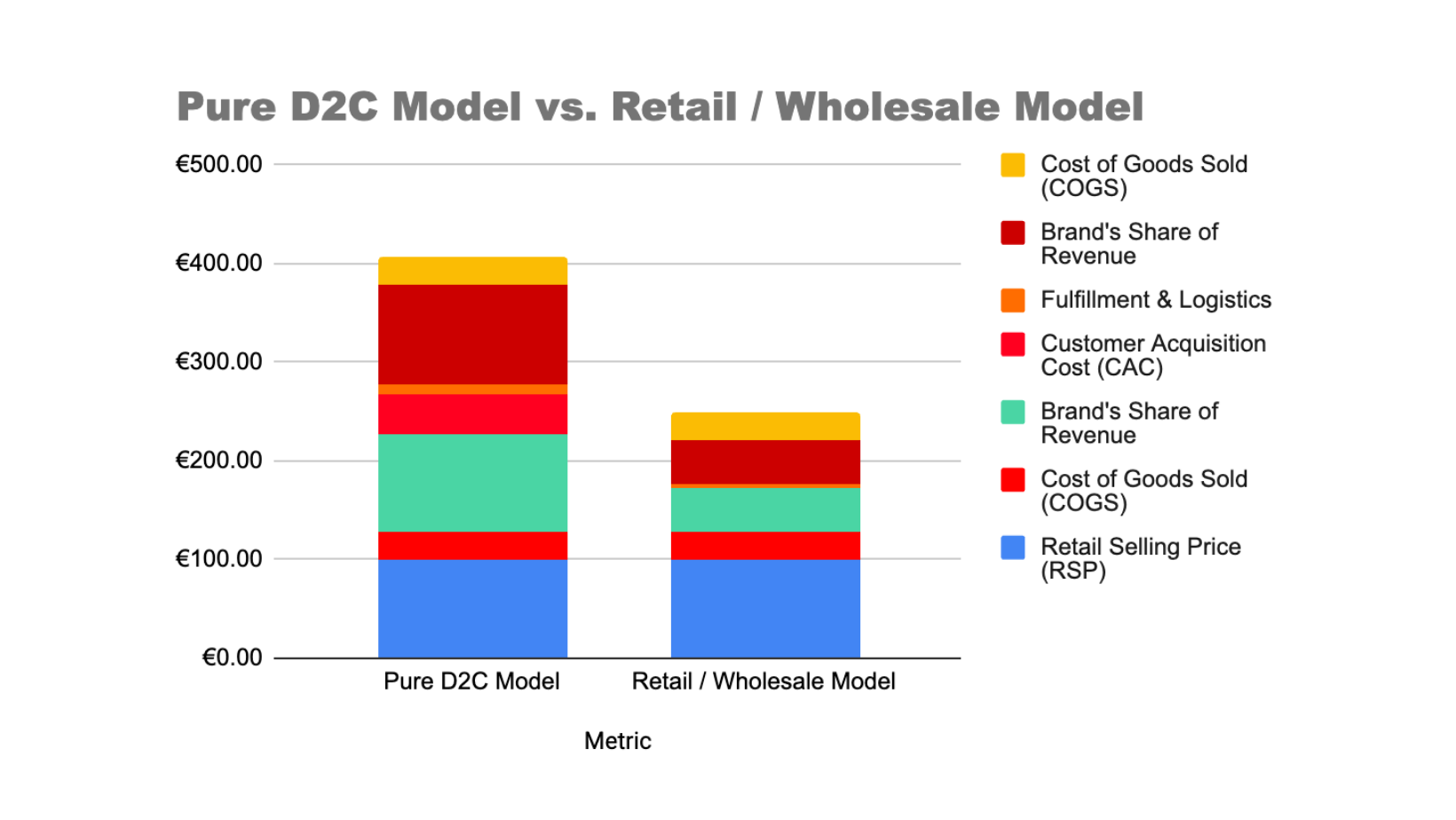
In contrast, partnering with retail networks gives your products immediate access to established physical footprint, massive existing foot traffic, and built-in consumer trust. Expanding into traditional retail can rapidly increase your brand awareness and boost overall sales volume without requiring higher ad spend. The trade-off comes in reduced profit margins, strict retailer compliance rules, and a complete loss of direct customer communication.
👉Let’s put it into practice:
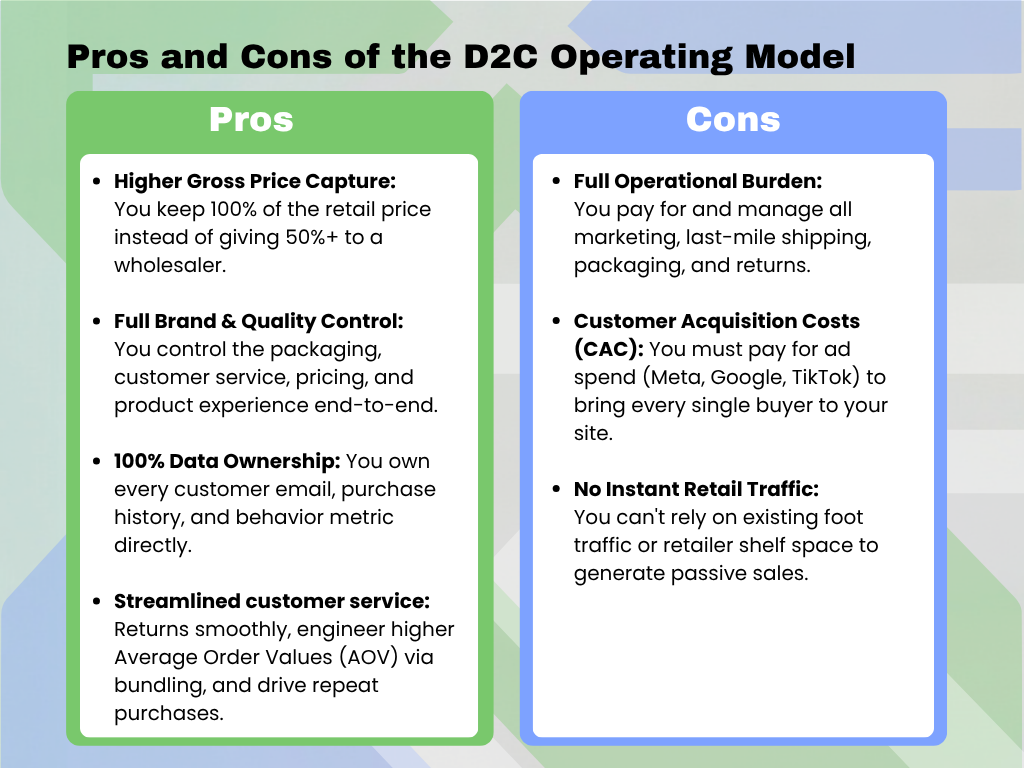
To understand how channel selection impacts your bottom line, consider a brand selling a premium product for €100 Retail Price (COGS: €28) across both models:
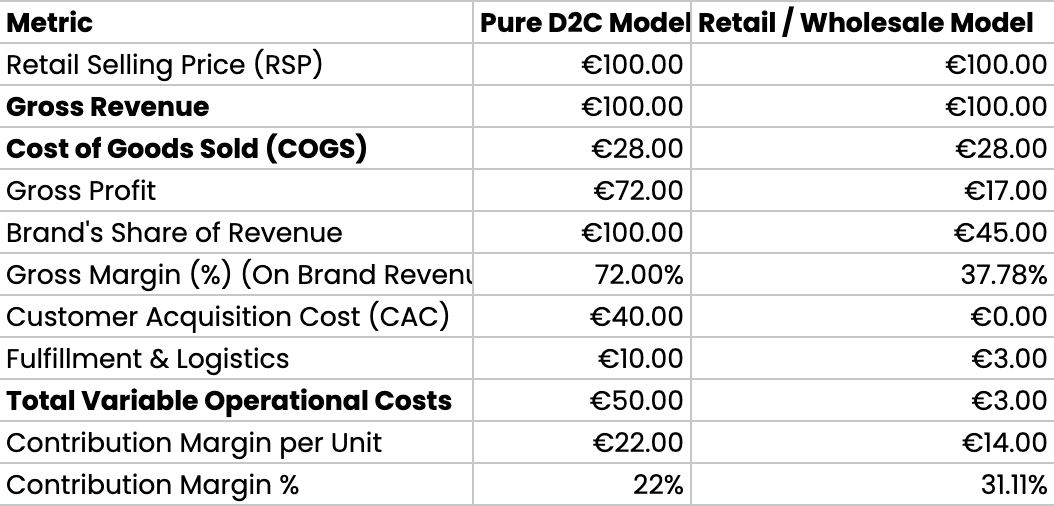
The D2C Operating Model: Pros and Cons
By controlling the entire supply chain—from custom manufacturing and quality control to customer experience and fulfillment—the brand captures full retail pricing and retains complete ownership of its customer data. While this model maximizes brand equity and customer lifetime value, a successful strategy requires strict unit-economics management to balance customer acquisition costs against fulfillment, returns, and ad spend to maintain profitable margins.
How to Sell D2C Across Multiple Channels
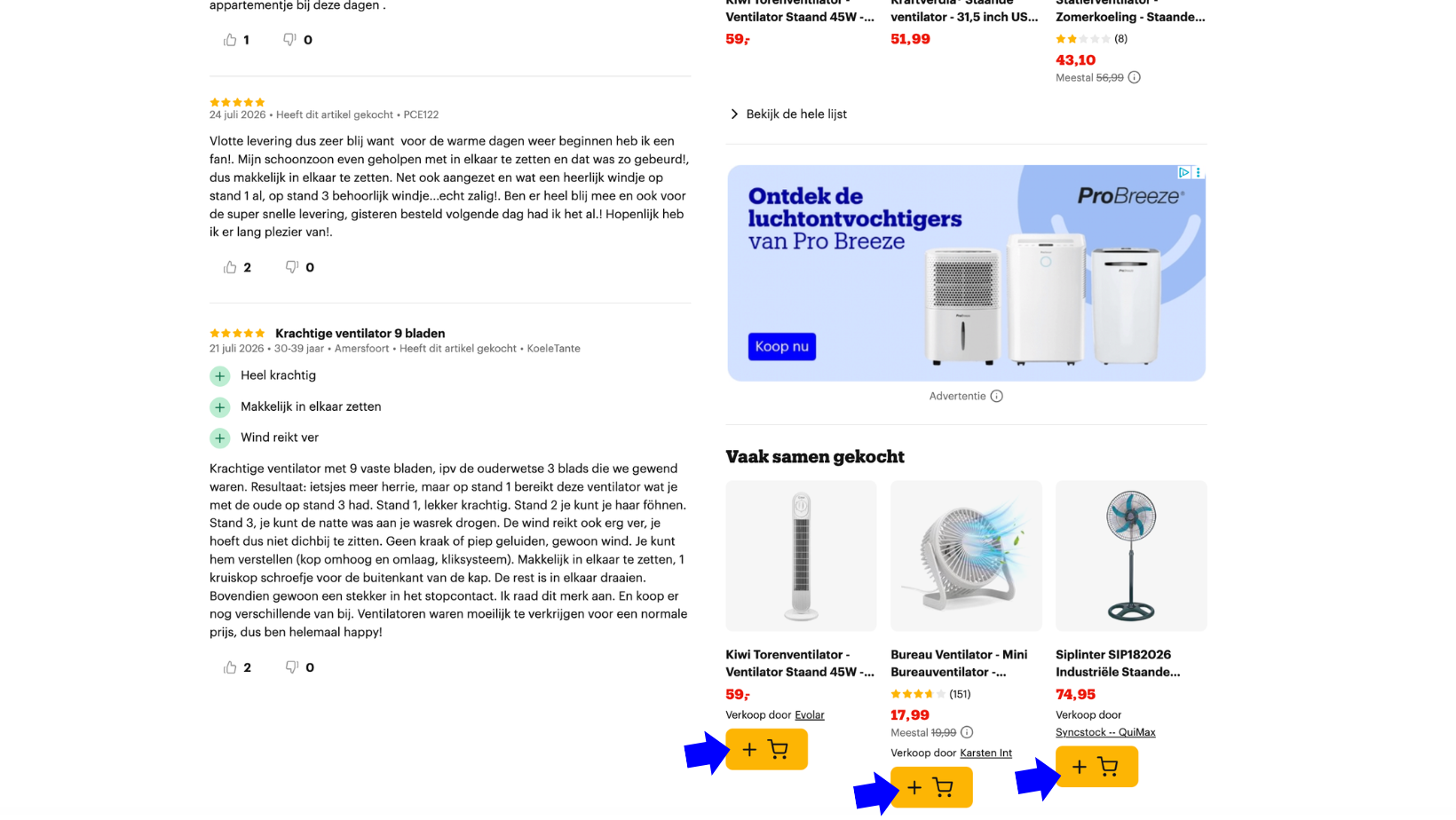
To bypass the lack of instant retail traffic and offset rising customer acquisition costs inherent to pure direct-to-consumer models, brands frequently adopt an omnichannel distribution framework. By leveraging a hybrid marketplace strategy, companies utilize established platform networks like Bol.com to capture top-of-funnel customer discovery, subsequently funneling buyers toward brand-owned webstores for higher-margin repeat purchases. Additionally, brands integrate a Direct-to-Store (DTS) model, shipping inventory directly to physical retail stores without relying on central retail distribution centers or wholesale middlemen. While large industrial breweries typically rely entirely on heavy wholesale distribution logistics, Brouwerij Duvel Moortgat, for example, maintains direct logistics and delivery networks to supply independent cafes, specialized bars, and select boutique bottle shops directly (specifically for their craft and specialty beers, as well as brand-owned operations like Vedett or La Chouffe). By shipping directly from the brewery/local hubs to retail outlets and local hospitality venues, they bypass traditional wholesale intermediaries to secure optimal shelf presentation, direct fresh-inventory control, and tighter relationships with local retailers.
👉This unified hybrid approach preserves brand integrity and maximum data ownership while systematically mitigating the operational burden and customer acquisition overhead associated with relying exclusively on primary webstore sales.
1. You Own the Unit Economics
Because you don't sell to a wholesaler at a 50% discount, you capture the full retail price. However, that also means you carry 100% of the operational costs—Customer Acquisition (CAC), last-mile shipping, pick-and-pack fees, and returns—which is why watching your contribution margin is essential.
2. You Control the Supply Chain & Quality
Quality Level Agreements (QLAs) — often referred to alongside or as a specific standard within Service Level Agreements (SLAs) — set contractually binding, measurable performance benchmarks between a D2C brand and its external partners (such as 3PL fulfillment centers, manufacturers, and technology platforms).
In traditional retail, a store network buffers operational mistakes. In D2C, your operational quality is your customer experience. A single broken promise (e.g., a late package, a wrong item, or a crashed website) immediately destroys brand equity and drains profit.
Wrongly picked orders mean double shipping costs, return processing fees, and lost inventory. A strong QLA includes financial service credits or penalty clauses. If a 3PL partner misses an agreed threshold, they absorb the financial impact instead of your brand.
3. You Build the Direct Customer Relationship
Instead of a marketplace like Amazon keeping your buyer's email, address, and purchase habits, you own the first-party data. This direct line lets you handle returns smoothly, engineer higher Average Order Values (AOV) via bundling, and drive repeat purchases—the main key to long-term D2C profitability.
Navigating the Marketplace Dilemma
Casestudy: The Financial Reality of Bol.com Versus Amazon
As Direct-to-Consumer brands scale, expanding onto digital marketplaces becomes less of a compromise and more of a strategic engine for top-of-funnel discovery. Moving beyond your native website requires a fundamental shift in how you evaluate unit economics and track profitability. On your brand storefront, your margins are constantly tested by rising social media acquisition costs and ad fatigue*, whereas marketplace platforms replace high upfront ad spend with dynamic, pay-as-you-go variable fees. Deciding where to list your inventory often comes down to a choice between two dominant marketplace powerhouses in the European landscape: Bol.com and Amazon. Choosing the right channel partner requires you to look past gross revenue metrics and examine how each platform directly impacts your net contribution margin.
(* Backed by research about ad-fatigue (2026)): Meta’s internal creative research shows that exposing the same audience cluster to a creative format repeatedly results in a 45% drop in Click-Through Rate (CTR) after just 4 repetitions.)
How does selling on Bol.com help protect profit margins for Benelux-focused brands?
If your brand focuses primarily on buyers within the Benelux region, Bol.com offers a distinctly favorable environment for protecting your bottom line. The platform operates on a strict commission-per-sale model, meaning you pay zero monthly account subscription fees and only incur costs when a transaction actually occurs. Because merchant density on Bol.com is relatively moderate compared to global giants, sponsored search ad costs remain reasonable, allowing you to maintain lower overall ad spend while achieving strong organic search positions.
📍bol.com functions as a low-risk, high-volume discovery engine, granting immediate market coverage across the Benelux without requiring heavy upfront customer acquisition investments.
Winning on Service, Not Discounts: How Bol.com Protects Your Margins
On Bol.com, winning the main purchase button (the "Buy Now") isn’t just about who has the cheapest price. Bol.com’s system gives priority to sellers who deliver orders fast, ship reliably, and maintain high service ratings. Because you don't have to slash your prices just to get sales, you can avoid destructive price wars and protect your profit margins.
Concrete Example
Imagine you and a competitor both sell the exact same leather backpack on Bol.com:
Competitor A lists the backpack for €85. They fulfill orders themselves, ship in 3 business days, and have an average seller rating of 8.0/10.
Your Brand lists the backpack for the full retail price of €100. You use Logistiek via Bol (Lvb) for guaranteed next-day delivery and maintain a 9.5/10 seller rating.
💡Even though Competitor A is €15 cheaper, Bol.com's algorithm will award the primary “By Now” button to your brand.
Bol.com knows local shoppers prioritize fast, reliable delivery over saving a few euros. Because you win the sale at your full €100 price point, you don't have to join a "race to the bottom" by discounting your product to €84 just to get noticed.
The Amazon Trade-Off: Balancing Cross-Border Scale Against Tight P&L Margins
Amazon, by contrast, helps you sell massive volumes across multiple countries, but it demands strict cost control to stay profitable.
Starting with a fixed monthly professional seller fee, Amazon demands up-front investment in on-platform advertisingto gain traction among intense global competition. Bid rates for sponsored keywords are consistently higher on Amazon, which often forces brands to dedicate 15-20% of their platform revenue purely to search visibility. Moreover, Amazon's buy-box algorithm favors the lowest absolute retail price, frequently triggering automated price wars that can erode your product margins over time. Despite these margin pressures, Amazon remains an unmatched vehicle if your primary goal is rapid, multi-country distribution across Europe using their deeply integrated cross-border logistics network.
⚠️When incorporating either platform into your internal P&L tracker, you must account for several variable line items that do not exist in standard wholesale contracts or native webshop sales. Beyond standard referral commissions, which typically range from 5-15% percent depending on your product category, you must subtract local value-added tax, variable pick-and-pack fulfillment charges, monthly inventory storage fees, and a dedicated allowance for return processing and inventory write-offs. While utilizing native fulfillment programs like Logistiek via Bol or Fulfillment by Amazon simplifies last-mile logistics, every operational touchpoint reduces your takeaway cash.
💡On an initial purchase, marketplace contribution margins often land in a similar range to direct-to-consumer webshop sales, but without the benefit of directly capturing first-party customer data for future retention marketing.
📍Aligning Channel Selection with Your Growth Goals
Ultimately, neither marketplace is universally superior, as the right choice depends on your brand's geographic footprint and target margin structure. If your immediate objective is to maximize net margin percentages and preserve brand equity within the Benelux market, Bol.com is financially safer and inherently more profitable on a per-unit basis.
If your growth strategy relies on capturing massive global order volume and expanding seamlessly into major European territories like Germany, France, and Spain, Amazon provides the necessary scale despite requiring higher ad spend and tighter margin management.
High-performing D2C brands do not view these marketplaces as direct competitors to their primary storefront, but rather as profitable acquisition channels engineered to capture broad consumer trust and fuel long-term business growth.
2. Product Sourcing & Logistics Models
Shipping D2C across the Benelux isn't a "one-size-fits-all" carrier game.
The Netherlands
PostNL: The undisputed market leader for home delivery and mailbox parcels.
DHL eCommerce NL: Strong runner-up with an expansive service-point and locker network.
Budbee (Instabee) & Trunkrs: High conversion drivers for eco-friendly, evening, and same-day delivery in major urban centers (Amsterdam, Rotterdam, Utrecht).
Belgium
bpost: The national postal operator and most trusted carrier for Belgian shoppers.
PostNL Belgium & DPD: Strong secondary options for cost-effective shipments coming from Dutch fulfillment centers into Belgium.
Mondial Relay: Popular budget choice for pick-up/drop-off (PUDO) networks.
Luxembourg
POST Luxembourg, DHL, and DPD handle the vast majority of last-mile deliveries.
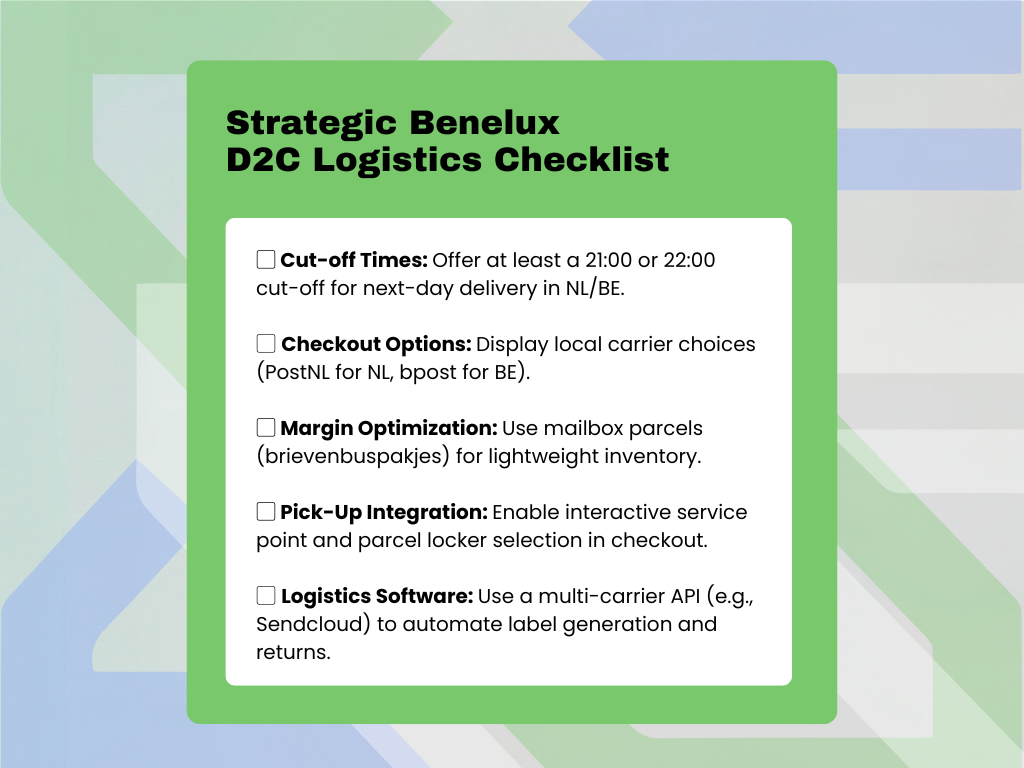
D2C Conversion Tip: Cross-border carrier hand-offs exist (e.g., bpost routing Dutch-bound orders via local partners), but surfacing the actual end-carrier brand (bpost in BE, PostNL in NL) in your checkout widget drastically improves conversion rates.
2. Delivery Formats You Must Offer
To optimize both unit economics and customer experience, Benelux D2C brands leverage three core formats:
Mailbox Parcels (Brievenbuspakje / Buspakje):
Best for: Small-format D2C products (apparel, cosmetics, supplements, accessories).
Why: Designed to fit standard mailboxes without requiring a signature or customer presence. They include end-to-end tracking and cost significantly less than standard parcel rates, directly protecting your gross margins.
Out-of-Home (OOH) & Parcel Lockers:
Rapidly expanding across Brussels, Antwerp, Amsterdam, and Luxembourg City.
Integrating interactive parcel-picker maps into your store checkout (e.g., PostNL points, bpost lockers) caters to eco-conscious shoppers and busy professionals while virtually eliminating failed first-attempt deliveries.
Zero-Emission Urban Delivery:
Major Benelux cities enforce Zero-Emission Zones (ZEZ) in city centers.
Utilizing carriers with EV fleets and cargo-bike distribution (such as DHL eCommerce, Budbee, and bpost’s eco-zones) guarantees compliant last-mile delivery into urban hubs while reinforcing your brand's sustainability stance.
Shipping Tech & Multi-Carrier Setup
Relying on a single carrier contract creates operational bottlenecks and restricts customer choice. Modern D2C brands use shipping management software to automate fulfillment:
Leading Benelux Shipping Platforms: Sendcloud (market leader founded in NL), Wuunder, Monta, and ShippyPro.
Dynamic Checkout Rules: Automatically route orders based on parcel weight, destination, and customer choice (e.g., route all Belgian orders > 2kg via bpost, and lightweight Dutch orders via PostNL Mailbox).
Localized Branded Returns: D2C shoppers expect low-friction returns. Automated portals that allow paperless QR-code drop-offs at nearby service points are critical for lifetime value (LTV) and customer retention.
Example: Logistics & Fulfillment Costs PostNL
To calculate your logistics and fulfillment costs when partnering with PostNL, you first need to distinguish between two different working models:
Shipping Only (where you or an external 3PL handle warehousing/packing, and PostNL delivers),
versus Full PostNL Fulfillment (where PostNL stores, picks, packs, and ships your orders).
PostNL Carrier Model P&L Framework
Below is the exact framework and formula required to calculate both shipping models for your profit and loss statement.
1. The Shipping Only (Carrier Model)
If you store and pack products in-house, your cost per order shipped through PostNL is determined by five primary variables.
A. Format and Weight Tiers
PostNL calculates base rates according to the physical dimensions and weight of each package. The Mailbox Parcel, known as Brievenbuspakje, supports a maximum size of 38 × 26.5 × 3.2 cm and a maximum weight of 2 kg. This option is significantly cheaper than standard parcels and does not require a customer signature. Standard Parcels, known as Standaard Pakket, allow dimensions up to 100 × 50 × 50 cm. Their weight brackets are typically divided into four tiers: 0 to 2 kg, 2 to 5 kg, 5 to 10 kg, and 10 to 23 kg.
B. Destination
The final destination of the shipment directly impacts your overall pricing. Shipping within the Netherlands establishes your base rate in euros (€). Crossing borders to deliver to Belgium or the wider European Union introduces an additional geographic surcharge per parcel.
C. Volume Tiers and Contract Discounts
PostNL operates on annual volume thresholds that determine your contract discounts. The higher your committed annual parcel volume—such as 2,500, 10,000, or over 50,000 parcels per year—the lower your base euro cost per shipping label will be.
D. Variable Surcharges (Toeslagen)
Variable surcharges represent a common profit and loss trap because merchants frequently forget additional fees that can erode 10% to 20% of expected shipping margins.
The fuel surcharge, known as brandstoftoeslag, is a fluctuating monthly percentage added on top of your base shipping rate in euros and is directly linked to diesel market prices. The peak season surcharge, or piektoeslag, is an extra euro fee per parcel applied during high-volume periods, which usually run from mid-November through December. Finally, manual handling fees for non-machinable parcels, known as handmatige verwerking, are triggered if a box exceeds standard dimensions, is cylindrical, or uses non-standard packaging material.
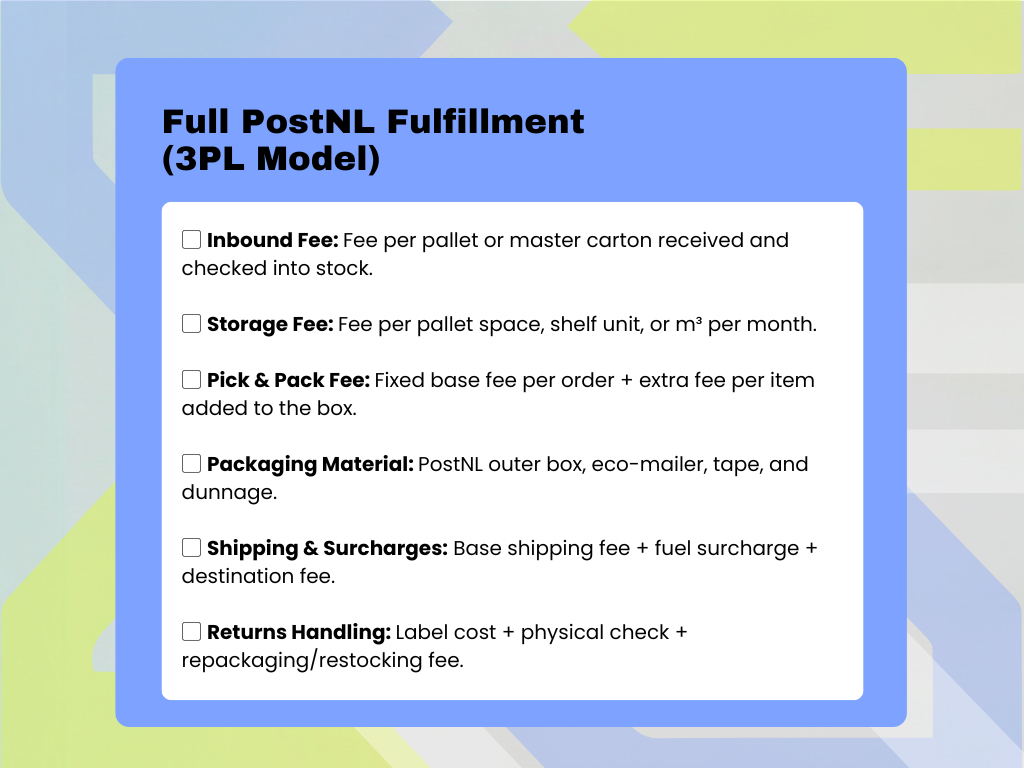
2. Full PostNL Fulfillment (3PL Model)
If PostNL handles your entire warehousing operation, your cost per unit expands to cover five operational touchpoints:
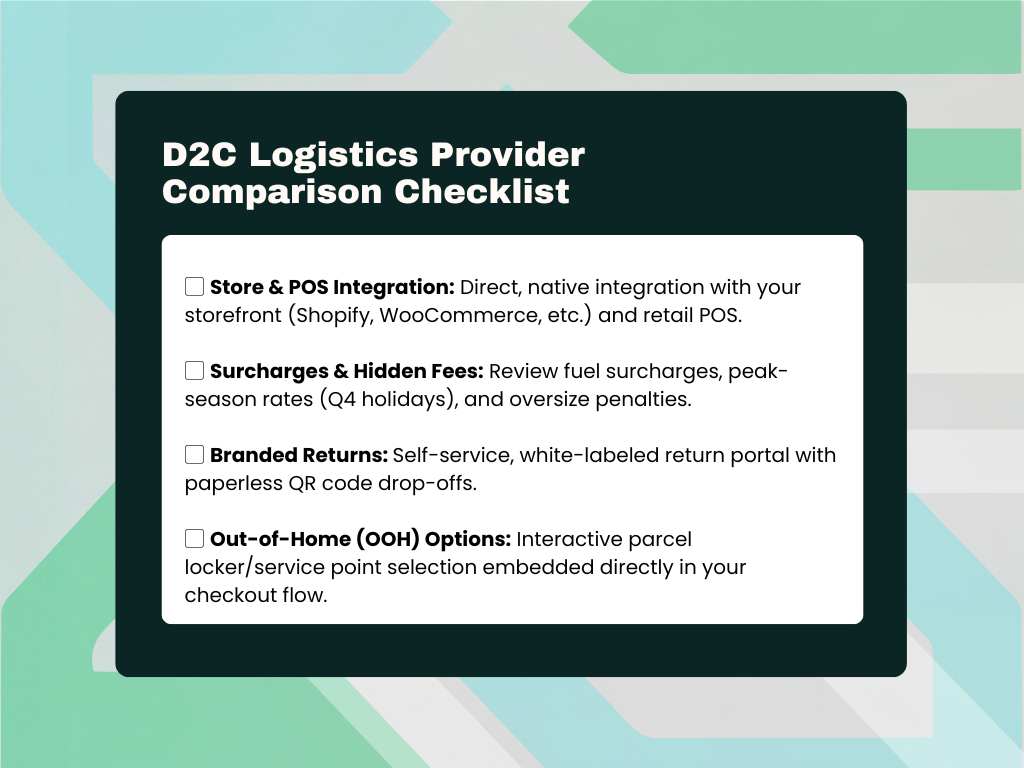
🧭 Finding the Right D2C Fulfillment Partner
Finding the right logistics setup comes down to three main factors:
1) Your order volume
2) Your e-commerce infrastructure (e.g., Shopify, WooCommerce), and
3) How much hands-on control you want over the unboxing experience.
Direct-to-Consumer brands have three primary paths for handling order fulfillment:
Option A: Multi-Carrier Shipping Platforms (Self-Fulfilled / In-House)
A multi-carrier shipping platform is software that connects an online store to multiple logistics carriers—such as PostNL, bpost, DHL, and DPD—through a single, centralized dashboard, with key market solutions provided by Sendcloud, Wuunder, ShippyPro, and SendMyParcel. Merchants frequently implement this model to access pre-negotiated group rates and secure instant volume discounts, even when operating at lower monthly order volumes. Furthermore, these platforms improve checkout flexibility by enabling online shoppers to select their preferred carrier and nearby pickup locations during purchase. Finally, they feature a seamless plug-and-play integration with direct-to-consumer platforms like Shopify or WooCommerce, allowing brands to optimize their fulfillment operations flexibly without committing to long-term contracts.
⚠️While these multi-carrier shipping platforms like Sendcloud, ShipStation, EasyPost, or Metapack simplify logistics by unifying carriers (like PostNL, DHL, DPD, and UPS) into a single API and dashboard, they add their own cost layer to your P&L on top of the raw carrier costs and surcharges.
Option B: Direct Carrier Contracts
The direct carrier contract model involves establishing formal business agreements directly with individual logistics providers such as PostNL, bpost, DHL eCommerce, or DPD. Signing direct contracts typically becomes financially advantageous once a merchant reaches a consistent shipping volume of 50 to 100 or more packages per week. Ultimately, this approach grants businesses the flexibility to negotiate custom pickup schedules, tailored rates for specific package dimensions, and direct service-level agreements.
Option C: E-Commerce Fulfillment / 3PL (Outsourced)
The third-party logistics model involves fully outsourcing warehousing, picking, packing, and shipping operations to a specialized 3PL provider, with key market leaders including Monta, Active Ants, and Salesupply. This fulfillment strategy is ideal for growing brands that lack physical warehouse space or wish to eliminate the labor required for manual pick-and-pack operations. Furthermore, partnering with a 3PL allows e-commerce businesses to offer aggressive cut-off times—such as ordering by 11:59 PM for next-day delivery—without the operational complexity and overhead of running an in-house night shift.
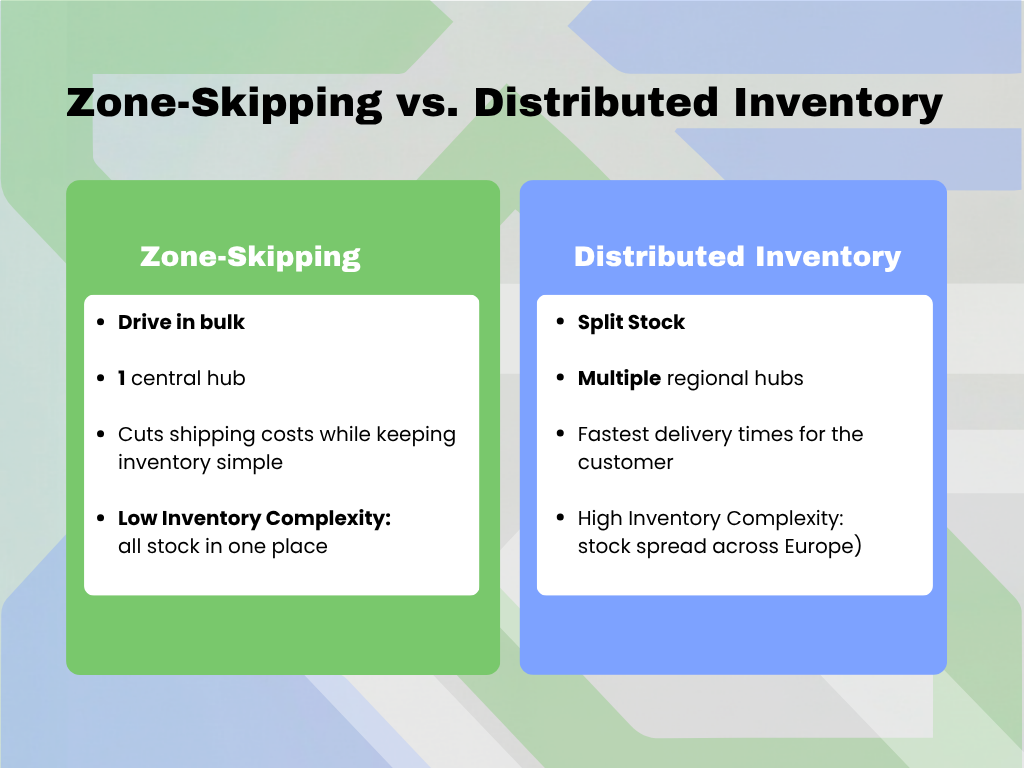
Zone-Skipping vs. Distributed Inventory: Stop Losing Profit to European Shipping Costs
Choosing the right European distribution strategy comes down to balancing operational simplicity against ultimate delivery speed.
Zone-Skipping
With zone-skipping, you keep all your stock in a single hub and ship bulk orders across borders directly to local postal depots, allowing you to slash cross-border fees without the overhead of managing multiple warehouses.
Distributed inventory
Conversely, distributed inventory splits your stock across regional European fulfillment centers closer to your buyers, which enables ultra-fast one- to two-day delivery at the cost of higher stock holding risks and split inventory complexity.
📍Ultimately, if you want lower shipping expenses while keeping operations lean, zone-skipping is your best move, but if your priority is outpacing local competitors on speed and you have the volume to justify spread-out stock, distributed inventory is the winning choice.
Scenario A: The Regional "Zone-Skipping" Model (Single Warehouse)
You store all inventory in a single central warehouse in Frankfurt, Germany, but target D2C customers across Spain and Poland.
How it works: Instead of paying high individual cross-border parcel rates for 80 weekend orders from Madrid, your 3PL loads all 80 orders onto a single pallet. A truck drives that pallet directly to a regional postal depot in Madrid.
The Final Mile: Local postal services (like Correos) unwrap the pallet and deliver the individual boxes locally.
The Benefit: You pay bulk freight for the long haul and cheap domestic rates for the last mile, dramatically reducing per-order shipping costs.
Scenario B: The Pan-European "Distributed Inventory" Model (Multiple Warehouses)
Your D2C brand expands across Europe and you want to offer 1-to-2 day delivery without paying high cross-border shipping fees.
The Strategy: Split inventory across strategically located 3PL warehouses (e.g., 60% in Germany for Central Europe, 20% in Spain for Southern Europe, 20% in Poland for Eastern Europe).
The Customer Experience: A Spanish customer's order routes automatically to the Madrid warehouse and arrives next day via local carrier.
The Benefit: Customer orders become domestic shipments, eliminating cross-border transit fees and reducing delivery times to boost repurchase rates.
Actionable Next Steps
Low to Mid Volumes (< 200 packages/month): Set up an account with a platform like Sendcloud, link your D2C store, and start printing labels using pre-negotiated discount rates.
Higher Volumes (> 200 packages/month): Request direct business quotes from PostNL/bpost and DHL, then benchmark those quotes against multi-carrier platform rates and 3PL fulfillment costs to protect your margins.
3. Product Catalog Management
The specific operational phase where you map out your product variations, write technical/attribute descriptions, and register unique identification numbers (SKUs, GTINs, or EAN barcodes) into your software (ERP, Shopify, or 3PL warehouse systems).
Product ID Requirements (Benelux)
For D2C brands selling in the Benelux region (Belgium, the Netherlands, and Luxembourg)—whether through your own webstore or across regional marketplaces like Bol.com and Amazon—product identification relies on globally recognized GTIN standards managed by GS1.
The specific Product ID requirements fall into two categories: Barcodes & Universal Identifiers (for systems and marketplaces) and EU Regulatory ID Labels (for physical compliance).
1. Barcode & Digital Identifier Standards (GS1)
To list products on major platforms or manage warehouse inventory, you need official GS1 identifiers:
EAN-13 (European Article Number): The standard 13-digit barcode used across the EU and Benelux. This is the primary requirement for selling on marketplaces like Bol.com, Amazon.be/.nl, and Zalando.
Note: Marketplace algorithms will cross-reference your EAN against the official GS1 database. Buying cheap, unauthorized barcodes from third-party websites can result in listing suspensions on Bol.com and Amazon.
UPC-A (Universal Product Code): The 12-digit US equivalent. While valid on global platforms, EAN-13 is preferred for Benelux-native logistics and marketplaces.
SKU (Stock Keeping Unit): Your internal ID code. Unlike EANs, SKUs are created by your brand to manage variations (size, color, style) in your own ERP or fulfillment center (e.g., Shopify, Activeants, or Amazon FBA).
2. Mandatory EU Packaging & Labeling Identifiers
When shipping products directly to consumers in the Benelux, EU regulations dictate specific physical identifiers on product packaging:
CE Marking (Conformité Européenne): Required if you manufacture or private-label electronics, toys, medical devices, or personal protective equipment (PPE). It certifies the product meets EU safety, health, and environmental standards.
EU Responsible Person / Importer ID: Under EU regulations (specifically Regulation EU 2019/1020), every CE-marked product sold in the EU must display the name and postal address of an EU-based Responsible Person or Importer.
Traceability Identifiers (Batch/Lot Numbers): Required on cosmetics, supplements, food, and electronics to allow target recalls if necessary.
WEEE Logo (Crossed-Out Wheeled Bin): Mandatory for electrical and electronic equipment sold in Belgium, the Netherlands, and Luxembourg for e-waste disposal compliance.
D2C Packaging: Steps To Take
To obtain official barcodes and comply with EU product labeling laws for a D2C brand operating in the Benelux region, there are four key steps to follow:
1. Register with GS1 Belgium & Luxembourg (for Barcodes & EANs)
Official EAN-13 barcodes must be obtained directly from GS1 Belgium & Luxembourg—the sole legitimate issuer. Using third-party reseller sites often leads to rejected listings on marketplaces like Bol.com or Amazon.be.
Determine Your Volume: Estimate how many total product SKUs (including variations like size or color) you will launch over time.
Select a Package:
Small Range (1–10 SKUs): Purchase a Product Code Pack (e.g., 10 GTINs/EANs for ~€60/year).
Growing/Large Range: Pay an annual membership fee to receive a unique GS1 Company Prefix. A company prefix allows you to generate hundreds or thousands of unique EAN-13 numbers yourself.
Generate Digital Barcode Files: Use GS1’s portal (My Product Manager) to assign codes to your SKUs and download high-resolution vector files (EPS or PNG) to print on your packaging or product tags.
2. Obtain CE Marking (If Applicable to Your Product Category)
If you produce or private-label goods in categories like electronics, toys, personal protective equipment, or medical devices, you must complete the CE certification process before selling in the EU:
Identify Applicable Directives: Determine which EU health, safety, and environmental regulations apply to your product.
Verify Compliance & Test: Test the product yourself or work with a certified laboratory (Notified Body) to ensure it meets safety thresholds.
Create a Technical File: Compile design documentation, test results, user manuals, and safety assessments into a technical dossier.
Sign the Declaration of Conformity (DoC): Draft an official document stating that your product meets all EU requirements.
Affix the CE Logo: Add the official CE logo to your product, packaging, and user manuals.
3. Appoint an EU Responsible Person (Required for Foreign/Non-EU Sourcing)
If you import goods from outside the EU (e.g., manufacturing in Asia or the US) that require CE marking, EU rules stipulate you must designate an EU-based entity:
Assign an Entity: This can be your registered company in Belgium/EU, an Authorized Representative service, or an EU-based importer.
Affix Contact Details: Print the Name, Registered Trade Name/Brand, and Postal Address of the EU Responsible Person directly on the physical packaging or an inserted document.
4. Final Packaging Proofing & Regulatory Labels
Before sending artwork to your printer, review your packaging against Benelux and EU consumer law requirements:
Language Compliance: Belgian consumer protection law mandates that product warnings, safety instructions, and ingredients must be provided in the official language of the region sold (Dutch in Flanders, French in Wallonia). Dual-language packaging (NL/FR) is the industry standard for Benelux-wide brands.
Waste & Recycling Logos: Include required recycling symbols on your packaging, such as the WEEE bin for electronics, the Green Dot (Fost Plus/VerpackSD) where applicable, or French Triman logos if shipping into French-speaking markets nearby.
Choosing a D2C Product Sourcing Model
There are three primary sourcing models used by D2C brands:
1. Custom Manufacturing (Original Design / Custom OEM (Original Equipment Manufacturer))
When you design a product from scratch, you partner with a contract manufacturer to produce it according to your exact specifications, materials, and quality standards.
The primary direct-to-consumer (D2C) advantage of this approach is that it yields the highest profit margins, grants complete control over product quality, and ensures full ownership of your brand’s Intellectual Property (IP).
However, the main trade-off is that it requires high upfront capital for tooling, molds, initial minimum order quantities (MOQs), and sample prototyping.
2. White-Labeling or Private-Labeling
In this model, you partner with a manufacturer that already produces a proven base formula or generic product, such as skincare, supplements, or apparel. You then customize the branding, packaging, unboxing experience, or minor ingredients and features to sell the item under your own brand name.
The primary direct-to-consumer (D2C) advantage is a significantly faster time-to-market along with lower upfront development and prototyping costs compared to custom manufacturing.
However, the main trade-off is lower product differentiation, as competitors can source similar base products from the exact same suppliers, and profit margins tend to be moderate compared to custom manufacturing.
3. On-Demand / Print-on-Demand Manufacturing
Under this model, products are produced individually or in small batches only after a customer places an order on your website. Once the order is placed, the production facility creates the custom product and immediately ships it directly to your end customer using your brand's packaging.
The primary direct-to-consumer (D2C) advantage is that it entirely eliminates inventory risk and warehousing costs, which allows you to test new product ideas with zero unsold inventory waste.
However, the main trade-off is higher per-unit production costs, which tightens your contribution margin and leaves less room to absorb customer acquisition costs (CAC).
📍As a general rule of thumb, true D2C brands avoid traditional wholesale buying—such as purchasing finished brand-name goods from distributors—because reselling someone else's product strips away your brand control, restricts your pricing power, and starves your margins after ad spend.
4. Legal & Store Policies
Before customers place an order on your site, they want to know that your business is safe, legitimate, and fair. Having robust legal and store policies protects your brand, keeps you compliant with platforms like Google, and removes friction for buyers at checkout. Let’s find out how to set up your legal and store policy.
You should include terms of service, which are legal agreements between a business and customers, and a privacy policy, which is a legal document that discloses some or all the ways a business gathers, uses, discloses, and manages a customer's data.
Google requires that all e-commerce businesses include this information for customer review.
👉You find useful templates in the E-Com Hub.
Product, Data, and Advertising Protocols in the Benelux
Expanding or optimizing your e-commerce operations in the Benelux region requires strict adherence to local consumer standards, data governance, and advertising rules. From managing localized product attributes and EU privacy compliance to structuring high-performing ad campaigns across channels, mastering these region-specific protocols is key to scaling your store profitably while maintaining customer trust. Let’s talk about the specific Product, Data, and Advertising Protocols every webshop owner operating in the Benelux must comply with.
👉You find useful templates in the E-Com Hub.
Ad-tracking Compliance
The Dutch (AP) and Belgian (GBA/APD) data protection authorities are among the strictest in Europe regarding ad-tracking compliance.
Google Consent Mode v2 & Pixel Tracking
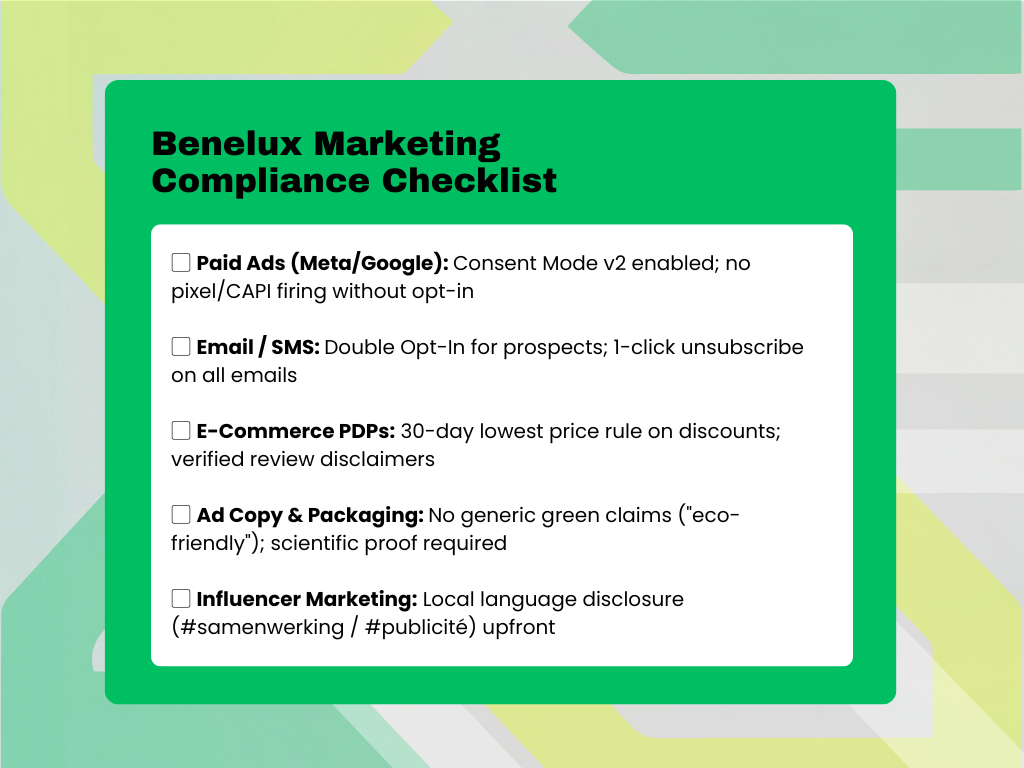
You cannot load marketing tags (Meta Pixel, TikTok Pixel, Google Tags) or pass user IDs/events until the user explicitly accepts marketing cookies.
Consent Banner UX: Under Benelux enforcement, dark patterns are illegal.
In the context of Consent Banner UX, a dark pattern refers to deceptive or manipulative design choices that subtly trick, nudge, or force users into agreeing to non-essential cookies and tracking.
The "Reject All" button must be as prominent and easy to click as the "Accept All" button on the initial banner screen.
Modern Server-Side Tracking
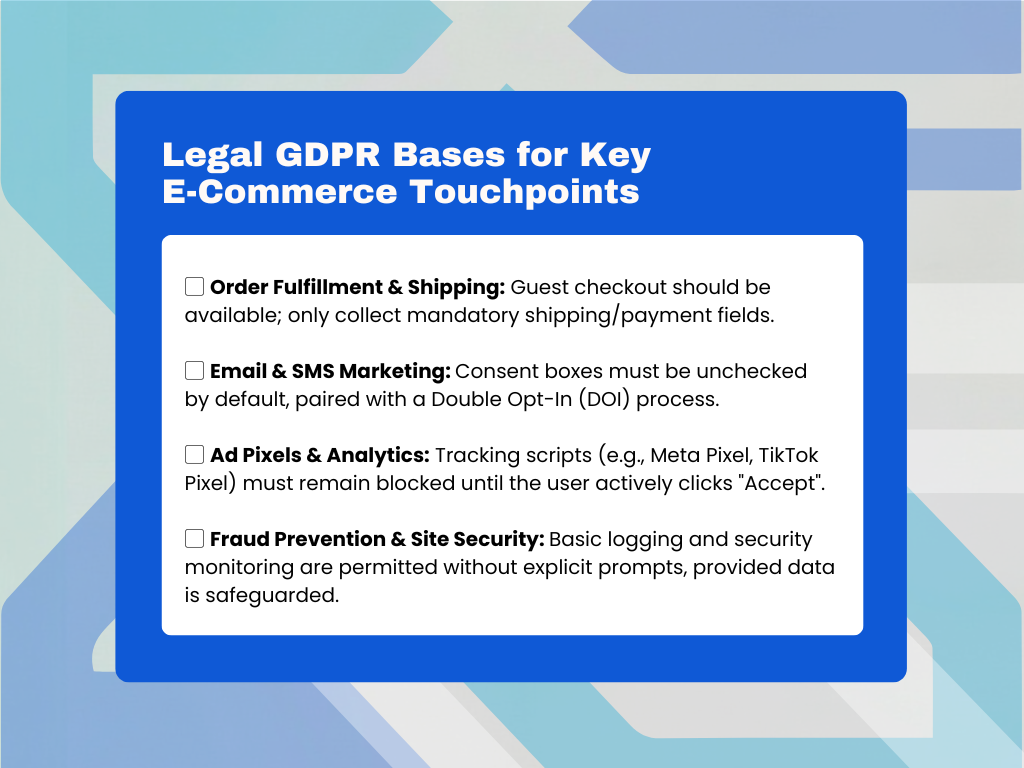
Server-Side Tracking (Meta CAPI): Moving from browser-based tracking to server-side tracking does not bypass GDPR. Sending hashed customer data (email, phone, IP) to ad platforms via server-side APIs still requires explicit marketing consent.
Instead of the browser talking directly to 10 different ad networks, the browser sends a single stream of data to a server that you control (usually running on a custom domain like metrics.yourbrand.com).
Explore tools like:
UserCentrics
Tracklution
Custom Audiences & Data Matching
Uploading customer list CSVs to Meta, Google, or TikTok to build Custom Audiences or Lookalike Audiences is legally classified as "data processing for targeted advertising."
⚠️You must have explicit consent (an un-checked opt-in checkbox at checkout or signup) that explicitly informs users their data may be shared with third-party ad networks for personalized advertising.
Email & SMS Marketing (ePrivacy)
While single opt-in is technically permissible under EU law, implementing a Double Opt-In (DOI) process serves as the de facto operational standard in the Benelux to protect your webshop against spam complaints and regulatory fines. Furthermore, you can rely on the "soft opt-in" exception to market related products to existing customers without prior explicit consent, provided you give them a clear opportunity to opt out during checkout and include a one-click unsubscribe link in every subsequent email.
Promotional & Pricing Protocols
If you run discount campaigns, Black Friday promotions, or flash sales in the Benelux region, your pricing strategy must comply with strict regional regulations. When displaying a strikethrough price, the original reference value must reflect the lowest price at which you offered the item during the preceding 30 days. Furthermore, artificially inflating prices right before a promotional period to advertise larger percentage discounts is illegal and actively monitored by the Dutch ACM and Belgian FOD Economie.
Review Authenticity & Social Proof
If you collect and display customer reviews in the Benelux, your webshop must strictly follow European consumer protection transparency laws. You are prohibited from buying reviews, publishing fake testimonials, or selectively filtering out negative feedback to showcase only five-star ratings. Additionally, your product detail pages must clearly disclose how you verify that reviews come from genuine customers who actually purchased the item, which is typically managed through verified order integrations like Trustpilot, Judge.me, or Kiyoh.
3. Green Claims & Environmental Marketing
"Greenwashing" is heavily penalized in the Benelux by regulators and advertising watchdogs (Reclame Code Commissie in NL, JEP in BE).
⚠️ You cannot use broad, unverified terms in your ads, landing pages, or product descriptions such as:
"Eco-friendly"
"100% Sustainable"
"Climate Neutral"
"Green Shipping"
Under Benelux regulations, any environmental claims you make about your products or fulfillment must follow a strict substantiation protocol backed by verifiable, publicly accessible data. To highlight green credentials, your claims need to be supported by formal Life Cycle Assessment (LCA) studies or recognized certifications such as GOTS, Fairtrade, or OEKO-TEX. Furthermore, labeling a product or delivery as "Carbon Neutral" based solely on purchased carbon offsets is restricted, as you are required to demonstrate active emissions reductions within your own supply chain first.
4. Influencer, Creator & Social Commerce Protocols
If you partner with creators or run influencer campaigns in the Netherlands or Belgium, transparency disclosures are non-negotiable.
Mandatory Disclosure Tags for Benelux Webshops
When you partner with influencers, send out gifted products, or run affiliate marketing campaigns, you are legally required to make those relationships transparent. Every paid post, product review involving gifted items, or affiliate link you publish or sponsor must feature clear, upfront disclosures written in the native language of your target audience.
Regional Disclosure Requirements
Netherlands (Dutch Market):You must include clear tags such as #advertentie, #samenwerking, or #partner on all promotional posts. Compliance and fair advertising in this market are monitored by the CvdM (Commissariaat voor de Media) and the Reclame Code Commissie.
Belgium - Flanders (Dutch Market):For your Dutch-speaking Flemish audience, you are required to use tags like #publiciteit, #reclame, or #gesponsord. Advertising standards and consumer protection regulations in Belgium are enforced by the JEP (Jury voor Ethische Praktijken inzake reclame) and FOD Economie.
Belgium - Wallonia (French Market):When targeting French-speaking consumers in Wallonia, your disclosures must use French terms such as #publicité, #sponsorisé, or #collaboration. These standards are also actively enforced by the JEP and FOD Economie.
Crucial Placement Rules for Your Shop
⚠️ Where you place these tags matters just as much as using them.
Your disclosures must always be visible "above the fold"—meaning the user can read the disclosure immediately without having to click "see more" or expand the caption. Additionally, you cannot bury your mandatory tags inside a block of 30 other hashtags; they must stand out clearly to protect your brand from legal fines and regulatory penalties.
5. Product Category Marketing Restrictions
If you sell regulated products in the Benelux, your marketing claims and advertising sets must comply with industry-specific health and safety restrictions. For cosmetics and skincare, you are limited to purely aesthetic benefits, as making medicinal or therapeutic claims like treating acne or curing eczema is prohibited. Similarly, any health claims for food and dietary supplements must be pre-approved and listed in the European Food Safety Authority (EFSA) database. Finally, alcohol promotions require age-gated targeting across advertising platforms and must feature mandatory regional warning messages, such as "Geen 18, geen alcohol" in the Netherlands or "Bier met liefde gebrouwen, drink je met verstand" in Belgium.
GDPR
The General Data Protection Regulation (GDPR) affects every webshop selling to consumers in the European Union or European Economic Area—regardless of whether the business is legally headquartered in Europe, North America, or Asia. For e-commerce operators, compliance extends far beyond copying a privacy policy template; it directly governs checkout design, marketing tracking, software integration, and customer retention workflows.
1. Core Principles Driving D2C Data Handling
If your webshop accepts orders, processes payments, or targets marketing toward EU residents, you are subject to full GDPR enforcement regardless of where your business is based. Under these regulations, you may only collect personal data strictly required for immediate processing, meaning fields like phone numbers or birth dates should not be mandatory at checkout unless logistically or legally necessary. Additionally, data gathered for a specific purpose cannot be recycled for other uses without explicit permission, so an email address collected solely to send a shipping receipt cannot automatically be added to a promotional marketing list.
Navigating Your Local Benelux Data Protection Authorities (DPAs)
If your webshop is ever audited or inspected for GDPR compliance, you will answer directly to the data protection regulator in your home country. Understanding who oversees your business—and what they focus on—helps you protect your store from costly fines and legal complications.
Your Regional Regulators & Their Core Focus
The Netherlands:
If you operate in the Dutch market, your local regulator is the Autoriteit Persoonsgegevens (AP). The AP is known for being extremely strict, with a heavy enforcement focus on unauthorized US data transfers, non-compliant cookie banners, invasive customer tracking, and issuing substantial financial penalties for violations.
Belgium:
For Belgian webshops, compliance is overseen by the Gegevensbeschermingsautoriteit (GBA) / Autorité de protection des données (APD). Their primary focus centers on requiring clear Data Processing Agreements (DPAs) with your vendors, ensuring absolute transparency in how you process customer data, and adhering strictly to European Data Protection Board (EDPB) guidelines.
Luxembourg:
If your business is based in Luxembourg, you fall under the jurisdiction of the Commission Nationale pour la Protection des Données (CNPD). The CNPD actively conducts oversight on cross-border data flows and places a strong emphasis on e-commerce platforms utilizing financial and cloud-based tech providers.
*EDPB compliance means following the rules, guidelines, and binding decisions set by the European Data Protection Boardto ensure proper application of the EU's General Data Protection Regulation (GDPR). It focuses on consistent data privacy practices and cross-border cooperation.
Managing Customer Rights & DSARs
Consumers possess explicit rights to request copies of their stored data (Right of Access) or demand full removal (Right to Erasure / "Right to be Forgotten"). Webshop owners must establish internal workflows to verify identities and fulfill these Data Subject Access Requests (DSARs) within 30 days without charging fees.
⚠️ Violations of the GDPR carry severe financial penalties—up to €20 million or 4% of total worldwide annual revenue. Beyond legal liability, clear and privacy-first data handling serves as a powerful trust accelerator that increases checkout conversion rates.
5. Product Profitability
Selling a lot of products doesn't automatically mean you're making money. True product profitability is what actually stays in your bank account after subtracting every variable cost—COGS, ad spend (CAC), shipping, processing fees, and returns—from your net revenue.
To see which items are genuinely driving your business, you have to look past top-line sales volume and weigh demand against these real expenses. In this chapter we’ll explore how to evaluate demand, calculate your net profit, and source products that protect your margins.
👉 Get Access to the P&L Tracker (template) for your business.
Analyzing Market Demand
Before building out margin spreadsheets, you must validate whether a real market exists for your concept.
💡In simple terms, demand measures how much consumers are both willing and able to purchase a specific product over a given period of time. In my experience, it comes down to three leading factors: willingness to buy, purchasing power and seasonality. (⚠️Demand rarely stays consistent throughout the year. You must factor in seasonal peaks and valleys (like holiday rushes or summer drop-offs) so you can forecast inventory needs and cash flow accurately.)
Calculating Product Profitability
Evaluating profitability comes down to a single question: Can you sell this product at a competitive price and still retain enough net profit to grow the business?
To find the answer, start at the very top with your total sales revenue:
Formula:
Total Revenue = Units Sold × Average Selling Price (ASP)
Once you have your top-line figure, the real work begins: tracking every single cost required to source, market, ship, and fulfill that product into your customer's hands.
Mapping Total Expenses
Net profit isn't just about what you paid for the raw item; it requires deducting every operational cost layer from your revenue (Access Your P&L Tracker):
Cost of Goods Sold (COGS): The direct cost of producing or acquiring the goods you sell. It includes raw materials, direct labor, and manufacturing overhead, but excludes indirect costs like marketing or distribution.
👉Subtracting COGS from Total Revenue gives you your Gross Profit.Packaging: Custom boxes, poly mailers, protective wrap, and unboxing inserts.
Shipping and Fulfillment: 3PL storage fees, pick-and-pack charges, and carrier postage.
Advertising: Paid acquisition costs across ad platforms (e.g., Meta, Google, TikTok).
Cost of Returns: Refund allocations, return shipping labels, restocking labor, and unsellable damaged inventory.
Additional Expenses: Payment processing fees, platform subscriptions, or customs duties.
Formula:
Total Expenses = COGS + Packaging + Shipping/Fulfillment + Advertising + Returns + Additional Expenses
The Net Profit Formula
Once all expenses are paid, the money left over is your Net Profit. To evaluate operational efficiency across different product lines, calculate your Net Profit Margin:
Formula:
Net Profit Margin (%) = (Net Profit/ Total Revenue) x 100
💡 Net Profit vs. ROAS:
Don’t confuse ad efficiency with actual business health. ROAS (Return on Ad Spend) only measures how much top-line revenue your ads generate relative to media spend—it doesn't guarantee you're turning a profit. A product can look great with a 4x ROAS on an ad dashboard and still lose money overall if high COGS, shipping costs, or return rates wipe out the remaining margin. At the end of the day, net profit is the only metric that tells you if your store is actually making money.
Product viability
Since the purpose of an online store is to make sales, you’ll need to research the viability of each product before you decide if you want to add it to your online store.
Product viability is the sales potential for a specific product. So, when determining the product viability of the items you want to sell, consider two things:
Demand: Is there a high enough demand for this specific product to make it worth selling?
Profit margin: Will you be able to sell this product at a competitive price while also making a profit?
How can you test product demand in the Benelux market before buying inventory?
Consider these options for the Benelux region:
1. Marketplace Analytics (Bol.com & Regional Platforms)
Since a significant portion of Benelux online shoppers start their product search directly on local marketplaces, marketplace analytics offer the clearest picture of actual purchase intent:
Bol Search Trends (Free inside Bol Partner Portal): The most direct source for Dutch and Flemish demand. It shows exact search term volumes, seasonal spikes, and category gaps directly from Bol.com’s database.
FiveX / e-pickr / Sellerly: Specialized local research tools built specifically to scrape and analyze Bol.com revenue estimates, review gaps, and competitor sales velocity.
Amazon Product Opportunity Explorer (NL & BE filters): Essential for tracking Amazon’s growing market share in Belgium and the Netherlands, showing niche conversion rates and search volume trends.
Marktplaats / 2ememain Insights: Excellent for evaluating local resale demand and price floors in the Dutch (Marktplaats.nl) and Belgian (2ememain.be) consumer-to-consumer markets.
2. Search Volume & Keyword Intent
Google Trends (Filtered to NL/BE): Crucial for detecting regional preference differences (e.g., product naming variations between Dutch "vaatwasser" vs. Flemish preference, or French search trends in Wallonia).
SEMrush / Ahrefs: Filter database location specifically to the Netherlands or Belgium. Look for commercial keywords with low keyword difficulty (KD) to spot underserved Dutch/Belgian niches.
3. Competitor Intelligence & Digital Shelf Tools
Benelux webshops face intense price transparency from aggressive local aggregators (like Kieskeurig.nl, Beslist.nl, or Tweakers for tech).
PriceShape / Omnia Retail: Benelux-native pricing and market intelligence tools. They track how competitors across NL/BE are pricing specific SKUs, stock availability, and market saturation in real time.
Meta Ad Library (Country Filter = NL/BE): Search competitor brands or keywords in the Netherlands/Belgium. Long-running ads in local languages signal proven, profitable demand in the region.
4. Consumer Validation & Macro Data
BUFFL (BE / NL): A localized consumer research platform with an active B2C community in Belgium and the Netherlands, allowing you to run rapid micro-surveys and test product concepts against local target demographics in hours.
CBS (NL) & Statbel (BE): Official national statistical offices providing free datasets on household spending habits, demographic shifts, and regional purchasing power.
6. Competitor Tracking
Tracking competitors has become even more important in a fast-pacing world. It is one of the fastest and efficient ways for benchmarking, discovering trends and identifying gaps.
If you do this manually, you will lose your mind. You can’t spend every morning clicking through twenty different product pages. Instead, you need an automated process based on what you want to track.
Here is why tracking competitors remains essential for your brand:
1. Keep in Mind: Why Paid Ads Aren't Enough
In a high-CAC landscape, living only by paid performance marketing on Meta, Google, and TikTok is how brands die. When CAC skyrockets, profitability requires moving beyond top-of-funnel acquisition to focus on LTV, retention, subscription velocity, and contribution margin per customer. Treating paid ads as the sole lifeblood ignores the broader unit economics.
2. Positioning & Finding "Market Gaps"
To sell directly to consumers, you must offer a clear reason why they should buy from you instead of someone else.
Analyzing competitor messaging, packaging, and unique selling propositions (USPs) reveals underserved customer needs. If all your competitors focus on "luxury finish" but customer reviews complain about durability, you can position your brand around "unbeatable durability".
💡 Historical performance data shows you what worked yesterday; it won't show you what the market lacks today. True innovators use competitor tracking to find unseen market gaps before the data catches up.
3. Protecting Pricing & Margin Flexibility
Even without wholesalers setting prices, consumers will tab-open 2–3 rival Direct-2-Consumer sites or check Amazon before making a purchase.
Tracking competitor pricing, bundle deals, and shipping thresholds (e.g., "Free shipping over €50") ensures your Average Order Value (AOV) and pricing tier stay competitive without unnecessarily undercutting your own contribution margin.
4. Learning from Competitor Reviews & Customer Friction
Your competitors’ public reviews (on Trustpilot, Google, or social media) are free product research for your brand.
If customers repeatedly complain that a competitor's sizing runs small, their customer support is slow, or their packaging breaks during transit, you can directly address those specific pain points in your own product design and marketing copy.
5. Keeping Pace with Retention & Lifecycle Tactics
Acquiring a D2C customer is expensive; retaining them via email, SMS, and loyalty programs creates profitability.
By joining competitors' newsletters or loyalty channels, you get direct visibility into their post-purchase sequences, win-back flows, and discount cadence. This helps you refine your own customer lifetime value (LTV) strategy.
📍In traditional retail, brands compete for physical shelf space. In D2C, brands compete for digital mindshare, ad placement, and customer trust. Tracking competitors isn't about copying them—it's about finding out where they fall short so your brand can step in.
7. E-comm Marketing Funnel
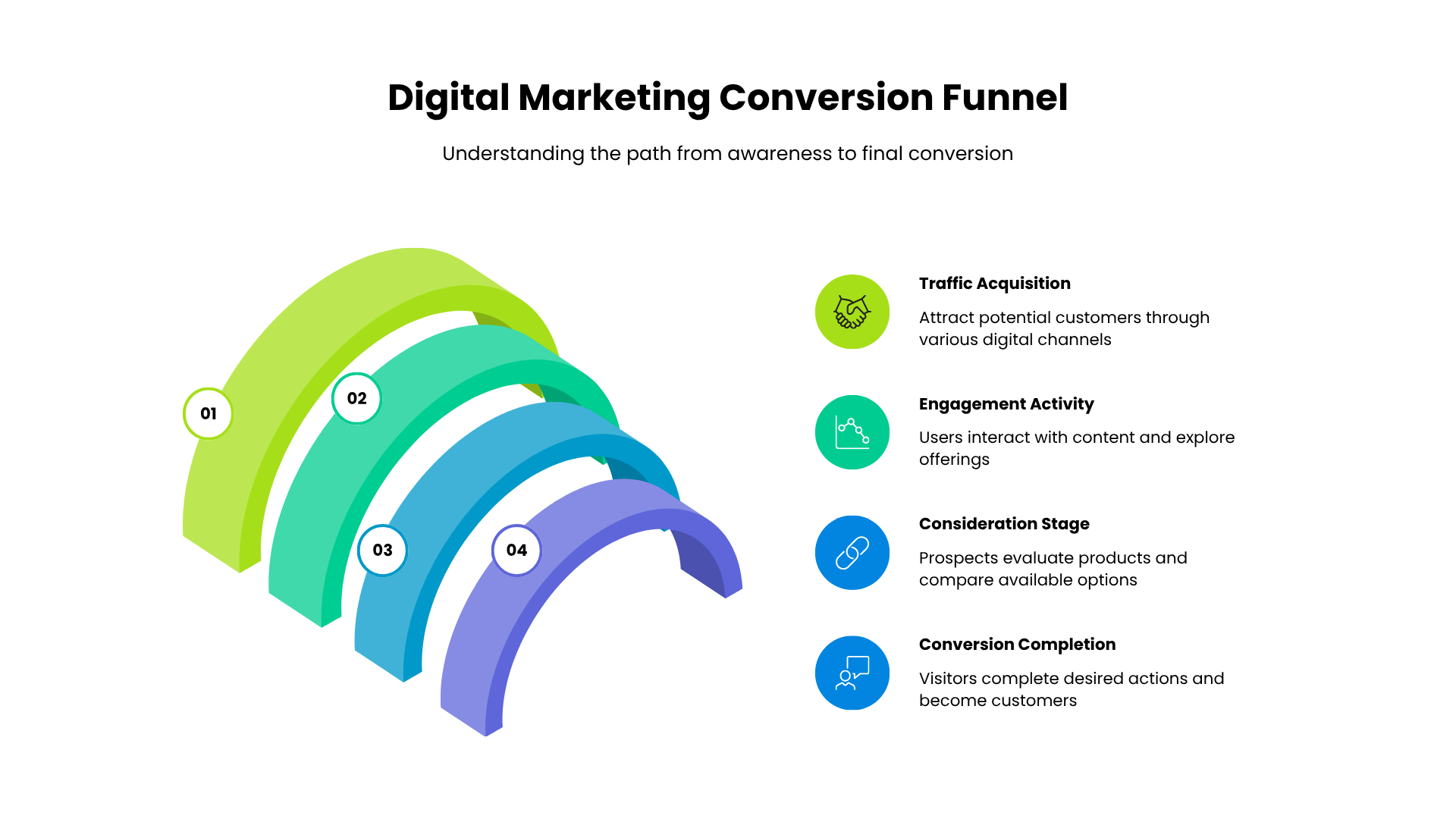
Customer touchpoints show you exactly how buyers discover, evaluate, and choose your brand. To effectively guide shoppers from their first visit to long-term loyalty, structure your e-commerce marketing funnel around these core stages:
Awareness: Build awareness of your e-commerce business.
Consideration: Build the brand.
Differentiation: Stand out in the business category.
Purchase: Reach shoppers most likely to purchase.
Brand readiness: Increase the potential for shoppers to make return purchases.
8. Loyalty Programs
Winning a customer’s first order is only the beginning; keeping them coming back is where real growth happens.
In an increasingly competitive market, effective loyalty programs do more than just reward purchases—they transform one-time shoppers into deeply engaged brand advocates. By aligning customer incentives with your business goals, the right model builds predictable revenue and drives long-term customer lifetime value.
This chapter breaks down the four core loyalty models that power repeat purchases, from steady points systems to premium subscription perks:
Points Model: Rewards long-term engagement across multiple orders.
Spend-Based Model: Drives immediate, higher average order value (AOV) per transaction.
Tier-Based Model: Builds prestige and gamified progression over time.
Subscription Model: Secures predictable, recurring revenue and sustained customer retention.
How to Elevate the Loyalty Program Experience
To make a loyalty program feel engaging rather than transactional, you should deliver value beyond basic discounts:
Personalize the Reward Journey: Use dynamic tokens (such as displaying the customer's first name, point balance, or progress toward their next reward) inside emails and account portals. Tailor special offers to match their past purchase habits, favorite product categories, or milestone events like birthdays.
Offer Tailored Incentives for Actions: Reward non-transactional actions that build long-term engagement, such as completing a preference quiz, writing a product review, or referring a friend.
Provide Experiential & Non-Monetary Perks: Give top-tier members exclusive experiences, such as early access to new product drops, invitations to private events, or priority customer support.
Incorporate Gamification & Progress Triggers: Use visual progress bars, streak challenges, and goal trackers to show customers how close they are to unlocking their next reward.
9. Marketing Priorities
Are you focusing on acquiring new leads or building customer loyalty? While both matter, they serve two very different goals.
Keep in mind: retaining an existing customer is 5x cheaper than acquiring a new one. Shift your focus toward keeping the customers you already have.
How Do You Align Marketing Goals with the Customer Funnel?
In other words: where are your marketing priorities (ToFU, MoFU, or BoFU)?
Let’s break it down.
1. Retention & Loyalty (Post-Funnel) — Highest Overall Priority
Rather than continually burning budget to acquire one-time buyers, Benelux D2C brands prioritize maximizing the Customer Lifetime Value (CLV) of existing buyers.
Focus Area: Driving repeat purchases through hyper-personalized email/WhatsApp marketing, VIP loyalty programs, and automated replenishment subscriptions.
Key Benelux Nuance: Consumers in the Benelux are notoriously value-conscious and quick to switch brands. Brands are moving away from simple "points-for-discounts" schemes toward "Loyalty 3.0" models—offering experiential perks, early product drop access, and personalized WhatsApp customer service flows.
Strategic Intent: Retention is significantly more cost-effective than acquisition, with repeat customers driving over 60% of total revenue for established e-commerce brands.
2. Bottom of Funnel (BoFU) — Driving Sales & Frictionless Checkout
Once a consumer expresses intent, converting them immediately is critical to maintaining positive unit economics.
Focus Area: Payment localization, mobile-first conversion rate optimization (CRO), dynamic cart abandonment flows, and explicit trust markers.
Key Benelux Nuance: Payment integration is the single biggest conversion factor in the Benelux. Dutch consumers heavily expect iDEAL (and the transitioning Wero standard), while Belgian consumers demand Bancontact alongside digital wallets. Additionally, over half of all online orders in the region occur on mobile smartphones, making instant mobile checkout non-negotiable.
Strategic Intent: Fixing "leaks" in the checkout stage yields immediate revenue gains without requiring extra performance marketing spend.
3. Middle of Funnel (MoFU) — Consideration, Lead Gen & Intent Capture
With standard paid retargeting becoming less effective due to strict privacy regulations, brands use MoFU strategies to collect first-party data directly from visitors.
Focus Area: On-site conversational AI discovery, style/fit quizzes, authentic user-generated content (UGC), and verified customer reviews.
Key Benelux Nuance: Benelux shoppers place immense weight on independent trust signals. Incorporating local review frameworks (such as Thuiswinkel Waarborg in the NL or Becom in Belgium) alongside authentic video reviews is vital. Furthermore, Belgian stores must deliver seamless, bilingual (Dutch/French) consideration journeys.
Strategic Intent: Converting anonymous site traffic into direct communication channels (email/SMS/WhatsApp leads) allows brands to nurture prospects without paying ad platforms for re-engagement.
4. Top of Funnel (ToFU) — Raising Awareness & Increasing Traffic
While still necessary for filling the pipeline, pure paid ToFU acquisition is receiving smaller shares of discretionary budget unless it generates highly targeted, organic reach.
Focus Area: Generative Engine Optimization (GEO), micro-influencer collaborations, and organic short-form social video (Instagram, TikTok).
Key Benelux Nuance: Traditional search is shifting as shoppers begin research inside AI tools like ChatGPT, Gemini, and Perplexity. Benelux digital marketers are actively optimizing brand content for GEO (making sure AI models cite their products) while partnering with local, authentic micro-influencers rather than costly macro-celebrities.
Strategic Intent: Building an authentic brand identity that captures organic traffic, ensuring the store doesn't rely entirely on paid ads to attract new visitors.
10. Brand Positioning Statement
Does your brand positioning statement outline what your company does, for whom, and what makes it different?
While a Brand Positioning Statement defines who you are to your customer, a Business Objective outlines what your company must achieve internally. Understanding this distinction is critical because each concept addresses completely different audiences, timelines, and practical outcomes for your store.
The Core Differences Breakdown:
Primary Focus:
Your Brand Positioning Statement focuses entirely on perception and identity by defining how you want your target shoppers to view your webshop relative to your competitors. In contrast, your Business Objective centers on performance and growth by establishing specific, measurable targets your company must hit to succeed financially and operationally.
Target Audience:
Your positioning statement targets an external audience because it shapes your marketing messages, product packaging, and overall customer experience. Conversely, your business objectives are meant for an internal audience, serving to guide executive decisions, budget allocations, team KPIs, and OKRs.
Underlying Nature:
Your brand positioning is qualitative, narrative-driven, and rooted in your unique brand identity. On the other hand, your business objectives are quantitative, metric-driven, and strictly time-bound, typically following SMART criteria.
Lifespan and Adaptability:
Your positioning statement operates on a long-term horizon, remaining consistent for years to help you build lasting brand equity. By comparison, your business objectives operate on a short- to mid-term basis and should be updated quarterly or annually as you hit targets or market conditions shift.
Real-World Example: A Sustainable D2C Footwear Brand
To see how this works in practice, consider how a sustainable D2C footwear brand applies both concepts:
Your Brand Positioning Statement:
"For eco-conscious urban professionals who refuse to sacrifice style for sustainability, [Brand] is the premium footwear company that crafts zero-waste sneakers, because only [Brand] uses 100% ocean-bound plastic with a closed-loop recycling guarantee."
The question this answers for your customer: Why should I buy from your shop instead of Nike or Allbirds?
Your Business Objective:
"Increase European D2C gross revenue by 35% year-over-year while reducing customer acquisition costs (CAC) by 15% through wholesale expansion."
The question this answers for your business: What specific financial performance do we need to deliver this year to grow?
📍Brand Positioning Statements and Business Objectives work hand in hand, with your positioning serving as the foundation that makes your commercial goals attainable. While your positioning statement establishes your unique value proposition in the market—such as being the most reliable or eco-friendly option—your business objective sets the specific target based on that identity, such as capturing a precise market share or revenue number. Ultimately, if your positioning fails to resonate with target customers, achieving your underlying business objectives becomes significantly more difficult and expensive.
11. OPEX Costs
Operational Expenses (OPEX) represent the day-to-day costs required to keep your e-commerce business running, growing, and generating revenue. Unlike Cost of Goods Sold (COGS), which tracks direct product costs, OPEX covers the essential overhead of running your store—from marketing, software, and logistics to payroll and administrative infrastructure. Managing these recurring expenses effectively is what ultimately determines whether a high-revenue webshop translates into a truly profitable business.
Payroll
Managing your webshop’s operational expenses (OPEX) requires balancing internal headcount with external expertise. When scaling an e-commerce business in the Benelux region (Belgium, the Netherlands, and Luxembourg), labor and service costs represent a significant portion of your ongoing operating budget.
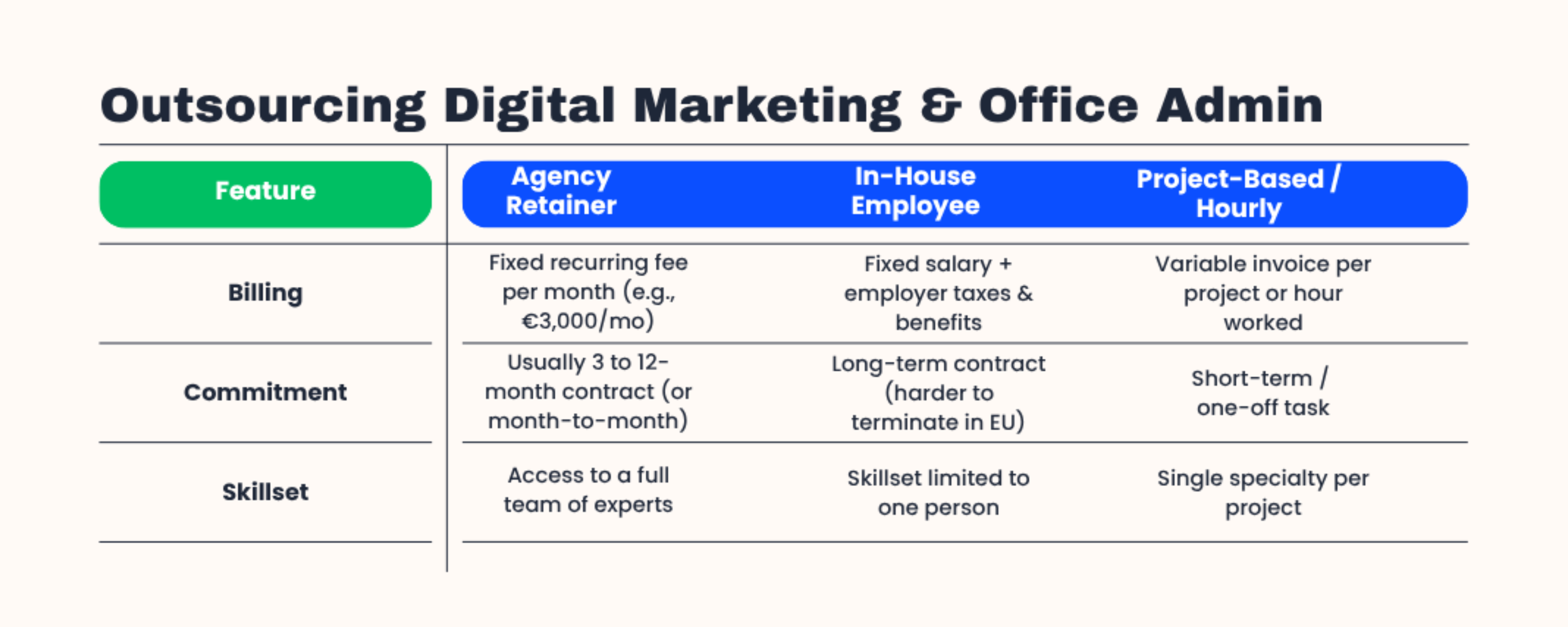
Navigating this investment effectively comes down to choosing the right talent model for your growth stage:
In-House Payroll: Building internal capacity gives you full dedicated focus, but comes with long-term commitments and substantial local employer payroll taxes.
Agency Retainers: Subscribing to an external team’s services provides immediate access to specialized skills (like ad buyers, CRO strategists, and copywriters) at a predictable, fixed monthly cost without payroll overhead.
Freelance / Project-Based: Offering flexibility for short-term, specialized tasks without recurring contract obligations.
Understanding how these resourcing models impact your Profit & Loss (P&L) allows you to build a lean, high-performing marketing structure that scales efficiently alongside your webshop's revenue.
Payroll is only one line item in your OPEX. To run a truly optimized e-commerce operation in the Benelux and beyond, you need to map out every single recurring expense powering your tech stack and backend operations.
Want a clear picture of your total operating costs? Jump into the E-Com Hub to calculate your complete OPEX and uncover immediate opportunities to boost your net margins.
12. Infrastructure
When looking at the core e-commerce infrastructure (e-commerce platforms / CMS) powering Direct-to-Consumer (D2C) brands in the Benelux region (Netherlands, Belgium, Luxembourg), the market is heavily consolidated at the top while leaving room for specialized local and enterprise players.
According to regional web-tracker data (such as Temb,), the top 5 e-commerce infrastructures account for roughly 80% to 85% of all active online storefronts in the Benelux.
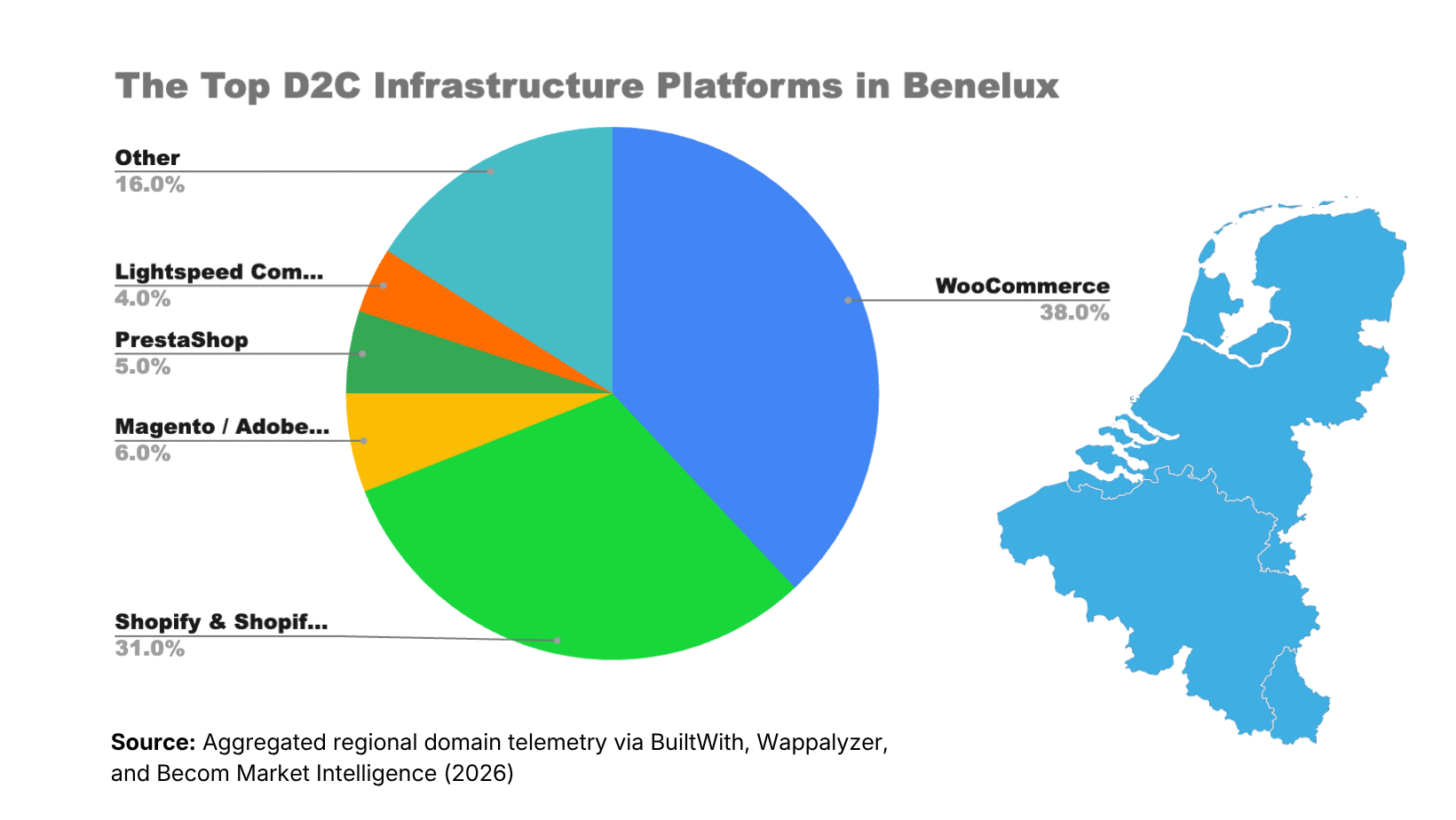
While dominant platforms like Shopify, Adobe Commerce, and WooCommerce command the lion’s share of the market, this ~16% "Others" segment is far from a passive remainder. It represents a highly strategic split between enterprise-grade customization on one end and frictionless SMB acceleration on the other.
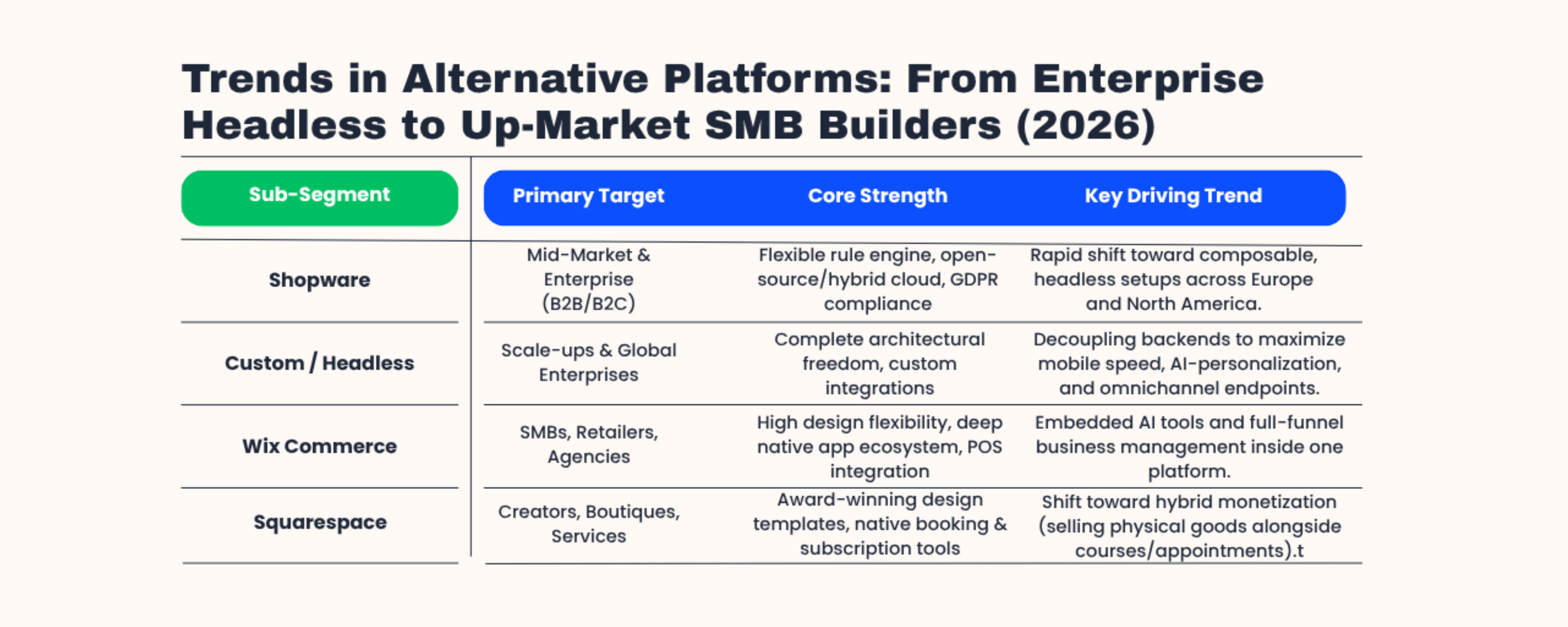
Trends in Alternative Platforms: From Enterprise Headless to Up-Market SMB Builders
While dominant platforms like WooCommerce and Shopify capture the majority of headline store counts, the remaining ~16% of the market represents where e-commerce architecture is actively evolving. This segment is not merely a collection of minor platforms; it reflects a sharp strategic polarization in how modern businesses build online. On one end, scaling enterprises are migrating toward flexible, headless architectures like Shopware to gain total operational control and strict EU data compliance. On the other, agile SMBs and creators are adopting elevated site builders like Wix and Squarespace to leverage native AI tools and unified business management. Understanding this 16% provides a clear look at the future of specialized e-commerce infrastructure.
1. Shopware: The Enterprise "Headless" Challenger
Shopware has evolved from a regional German favorite into a major global competitor, particularly in mid-market and enterprise B2B/B2C setups.
API-First & Headless Adoption: Shopware 6 was designed ground-up for API-first commerce. Businesses wanting the speed and custom UX of modern frontends (using Vue/Nuxt via Shopware Composable Frontends) leverage Shopware strictly as a robust backend engine.
B2B & Complex Rules Engines: Unlike light SaaS solutions, Shopware natively handles intricate B2B requirements (custom price books, multi-tier approvals, complex rule builders) out of the box without needing dozen-app stacks.
GDPR & Sovereignty: For European brands or global companies handling EU data, Shopware’s strong compliance foundation and self-hosting flexibility offer localized control that US-centric SaaS platforms struggle to match.
2. Wix & Squarespace: Up-Market Evolution for SMBs
Historically viewed as basic website builders, Wix and Squarespace have aggressively built out serious e-commerce infrastructure to move up-market.
Advanced Engine Capabilities: Wix now includes native multi-channel syncing, deep POS integrations, local delivery handling, and AI-driven conversion personalization out of the box.
Creator & Service Integration: Squarespace dominates creator commerce by acquiring and fully embedding tools like Acuity Scheduling, paid subscriber communities, and digital product portals.
AI-First Generation & SEO: Both platforms heavily rely on AI site generation (e.g., Wix's AI assistant or Squarespace's Beacon AI) to let small business owners build performance-optimized, localized storefronts in minutes instead of weeks.
Critical features in future eCom infrastructure
Is your technical setup holding your webshop back from its next growth phase? From handling regional shipping preferences in the Benelux to integrating AI-native personalization and real-time ERP syncing, your backend infrastructure dictates your bottom line. Go through this checklist to ensure your store's architecture is fully equipped to handle modern operational complexities and drive long-term profitability.
☑️ Localized Storefronts: Adapting your website for regional currencies, local payment methods and translated landing pages.
💡Consumers in the Netherlands and Belgium have distinct local preferences; displaying their preferred carrier logo at checkout directly reduces cart abandonment.
☑️ Agentic commerce (to optimize your webshop for non-human buyers): structured API data, machine-readable product specifications.
☑️ POS–eCommerce Integration: connecting their in-store registers directly with online inventory (to maintain real-time stock clarity and unified customer records)
☑️ ERP: Landed COGS tracking, warehouse management (WMS), purchasing/procurement, financial accounting, and centralized stock allocation.
☑️ AI-native storefronts: delivering real-time dynamic hyper-personalization. Storefronts are evolving into adaptive digital spaces that alter layouts, product rankings, and promotional copy instantly based on individual user behavior (which leads to hyper-localized consumer experiences)
☑️ Private communication channels on platforms (for example WhatsApp integration) helps brands boost direct customer retention without relying solely on paid ads.
☑️ Context-Aware Pricing API: Standard e-commerce platforms store one static base price per SKU. A flexible infrastructure uses a contextual pricing layer capable of evaluating price based on the buyer's session context.
☑️ Frictionless back-end logistics
☑️ Decentralized Storytelling Network or Peer-to-Peer (P2P) Publishing Architecture: enables authentic local storytelling
☑️ Inventory Planner (to prevent stockouts, and enable inventory replenishment, backorders, and cash flow projections based on real-time sales velocity.
☑️ Distributed 3PL Warehousing: Partnering with international 3PLs to store inventory locally in target regions (e.g., UK, EU, Australia). This eliminates international customs duties, lowers cross-border shipping costs, and speeds up delivery times for overseas buyers.
☑️ Competitor Tracking (like competitor pricing)
☑️ Customer Feedback Tool (for example from NPC to Consumer Intelligence)
☑️ Instant Load Speed
☑️ Custom Price Books
☑️ Multi-Tier Approvals
☑️ GDPR & Sovereignty
☑️ Native multi-channel syncing: built-in capability to connect, manage, and synchronize your product catalog, inventory levels, orders, and pricing across multiple sales channels (like Amazon, eBay, Google Shopping, Meta, and TikTok) directly from one central dashboard—without needing third-party plugins or external middleware.
☑️ Consumer Interface (CI): enables customer to interact directly with a brand to browse, evaluate, or purchase products.
☑️ Shared Payment Tokens (SPTs): this system allows AI agents to securely transmit purchase authorizations to major retailers—including Etsy, Coach, and Urban Outfitters—without exposing sensitive credit card details.
☑️ Native backend integration for global standards like the Agentic Commerce Protocol (ACP) and Universal Commerce Protocol (UCP): This setup allows merchants to expose machine-readable endpoints out of the box without building expensive custom integrations.
☑️ App-Like Functionality: to support native mobile features such as push notifications for abandoned carts or promotional campaigns, full-screen browsing without browser search bars, and fluid touch gestures (mobile-first commerce)
☑️ Offline and Low-Connectivity Browsing: If a customer loses their internet connection—such as while traveling on a train—they can still view recently browsed products, access saved shopping carts, and review saved store information.
☑️ Native Support for Agentic Protocols: actively supports industry standards such as Google's Universal Commerce Protocol (UCP), OpenAI and Stripe's Agentic Commerce Protocol (ACP), and the Agentic Experience Protocol (AXP).
☑️ Personalization Capabilities: The ability to tailor the shopping journey using data-driven tactics, such as:
Utilizing personalization tokens (e.g., dynamic names or tailored product recommendations) in customer communications.
Automating targeted promotions for special events and milestones (like birthdays or anniversaries).
Deploying tailored messaging that matches exactly where customers are in the sales funnel (awareness vs. consideration vs. decision).
Triggering relevant follow-ups based on past interactions (such as abandoned carts or complementary product suggestions).
☑️ Secure Checkout: Features a built-in, mobile-optimized shopping cart that securely protects customer data.
☑️ Shipping & Inventory Management: Built-in shipping and fulfillment options that sync effortlessly while keeping track of real-time stock levels using SKUs (Stock Keeping Units).
☑️ Marketing & Content Tools: Built-in email marketing, SEO tools, and ad campaign management alongside an integrated blogging platform to share valuable content and drive organic traffic.
☑️ Analytics & Reporting: Real-time dashboards and performance reports that can be easily shared with stakeholders to track store growth, monitor conversion rates, and map out future ad budgets.
☑️ 24/7 Support: Round-the-clock access to online help centers and customer service teams whenever technical or operational issues arise.